For over a century, the automotive industry defined itself by horsepower, displacement, and mechanical craftsmanship. Engineering success was measured in engine blocks, transmission gear ratios, and chassis dynamics. Today, however, that legendary mechanical race has been eclipsed by lines of code, neural networks, and over-the-air updates.
The convergence of Software-Defined Vehicles (SDVs) and artificial intelligence is fundamentally upending traditional automotive engineering, shifting the entire industrial paradigm from hardware-centric manufacturing to continuous, software-driven mobility ecosystems.
The Shift from Hardware to Software-Defined Architecture
For decades, modern cars operated on decentralized networks choked by dozens—sometimes over a hundred—of disparate Electronic Control Units (ECUs), each running proprietary software from different suppliers. This siloed architecture made updating vehicle features nearly impossible once a car left the factory floor.
The emergence of the Software-Defined Vehicle has shattered this model. Automakers are rapidly transitioning toward centralized domain controllers and powerful vehicle computers that govern distinct zones (such as propulsion, safety, and infotainment). This decoupling of hardware and software allows vehicles to continuously evolve. Through Over-the-Air (OTA) updates, automakers can fix bugs, enhance battery efficiency, unlock new safety capabilities, and upgrade user interfaces long after the vehicle has rolled off the assembly line.
The AI Engine: Transforming Vehicle Capabilities and Cockpits
Artificial intelligence sits at the heart of this transformation, reshaping both how vehicles operate and how humans interact with them.
1. Intelligent Cockpits and Generative AI
Cabin experiences are undergoing a radical evolution. Traditional static infotainment displays are being replaced by adaptive, conversational assistants powered by generative AI. These systems can interpret complex natural language, anticipate driver preferences, adjust cabin biometrics, and seamlessly manage vehicle functions without requiring the driver to dig through nested menus.
2. Autonomous Driving and Neural Processing
Advanced Driver Assistance Systems (ADAS) and Level 3 automation rely heavily on machine learning models. Instead of relying solely on hard-coded rules, neural networks process massive streams of real-time data from LiDAR, radar, and high-definition cameras. This shifts automotive engineering verification from traditional deterministic programming to validating probabilistic AI models capable of handling unpredictable, real-world traffic scenarios.
The Engineering Cultural Revolution
This technological pivot has forced a profound cultural and structural transformation inside traditional automotive engineering organizations.
- From Pistons to Pipelines: Legacy automakers are restructuring their engineering teams to mirror Silicon Valley tech firms. They are implementing Agile methodologies and CI/CD (Continuous Integration/Continuous Deployment) pipelines to push software builds to vehicles rapidly and securely.
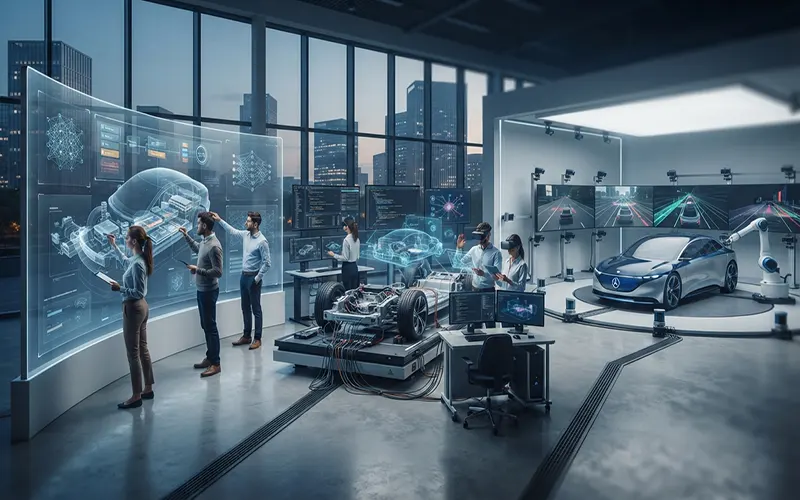
- Simulation and Digital Twins: Physical prototyping is slow and expensive. Modern engineering teams rely heavily on digital twins and synthetic testing environments. Millions of virtual miles are logged in simulation farms to test edge-case AI scenarios and software patches before a physical prototype ever touches a test track.
- The Talent and Supply Chain Shift: Tier-one suppliers and automakers are locked in a fierce global competition to recruit cloud architects, machine learning engineers, and cybersecurity experts, fundamentally altering what it means to be an automotive engineer.
Road Ahead
The modern car is no longer just a mechanical machine; it is a high-performance data center on wheels. As software-defined architectures and artificial intelligence continue to mature, the winners of the next automotive era will not simply be the companies that build the best chassis, but those that successfully master the complex marriage of reliable physical hardware and adaptable, AI-driven software engineering.