
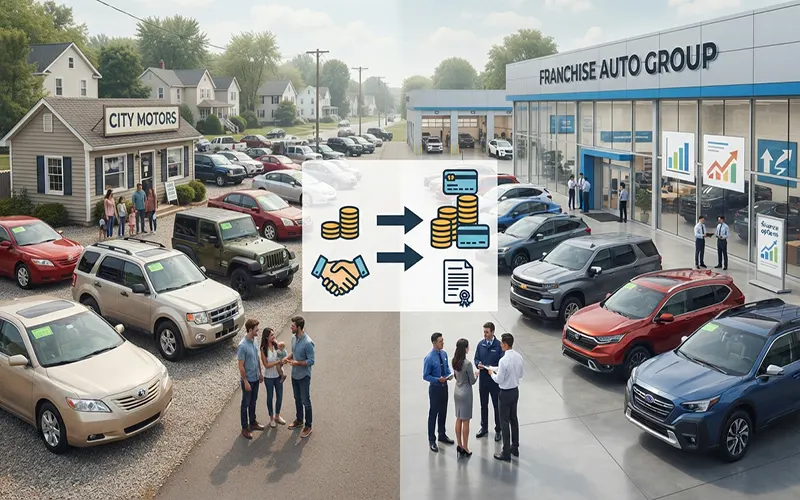
Walking onto a car lot can feel like stepping into two entirely different worlds: the sprawling, brand-badged franchise showroom or the independent lot lined with a colorful mix of makes and models.
When it comes to scoring the “best deal,” neither independent nor franchise dealerships hold a monopoly on savings. Instead, each offers distinct pricing advantages, inventory sources, and negotiation dynamics depending on what type of vehicle you are buying and how you plan to finance it.
Anatomy of a Franchise Dealership: Pros, Cons, and Pricing Power
Franchise dealerships operate under direct contracts with major automakers (e.g., Ford, Toyota, BMW). They have exclusive rights to sell brand-new cars and hold first pick of the best pre-owned inventory.
- Inventory Sourcing & CPO Perks: Franchise stores dominate the market for late-model, low-mileage lease returns. They offer Certified Pre-Owned (CPO) vehicles that undergo rigorous multi-point manufacturer inspections and come packaged with factory-backed warranties.
- Captive Financing Leverage: Because they are tied to manufacturer financing arms (like Toyota Financial Services or Ford Credit), franchise dealers can offer subvented rates, such as 0% or low-APR promotional financing, that independent lots cannot match.
- The Overhead Factor: Massive glass-walled showrooms, mandatory brand appearance standards, and large corporate staffs create high operating overhead. This rigidity can translate to less flexible pricing on lower-margin vehicles.
Anatomy of an Independent Dealership: Flexibility, Auctions, and Bargains
Independent dealerships are locally owned businesses with no direct ties to a single automaker. They specialize entirely in pre-owned vehicles across a massive spectrum of ages, brands, and price points.
- Inventory Sourcing: Independents acquire their stock primarily through wholesale dealer auctions, trade-ins, and fleet liquidations. Their lots feature everything from budget-friendly older commuters to mid-tier family SUVs.
- Aggressive Pricing and Lower Overhead: Without corporate guidelines or expensive showroom mandates, independent dealers carry much lower overhead costs. This allows them to price older, high-mileage, or budget-tier used cars much more competitively.
- The Risk Factor: Independent lots do not offer factory CPO programs. Vehicle conditions vary wildly, making a thorough Pre-Purchase Inspection (PPI) by an independent mechanic an absolute necessity before buying.
Head-to-Head Comparison: Where the Real Savings Live
| Comparison Criteria | Franchise Dealerships | Independent Dealerships |
| Primary Inventory | New cars and late-model, low-mileage used/CPO vehicles | Diverse mix of pre-owned, older, and budget-friendly vehicles |
| Financing Perks | Access to captive lenders, low-APR promotional rates | Specialized third-party lenders; often flexible with credit rebuilding |
| Pricing Structure | More standardized; higher baseline due to corporate overhead | Highly competitive and negotiable on older inventory |
| Warranties | Manufacturer-backed CPO warranties | Third-party service contracts or dealer-backed limited warranties |
Smart Shopper’s Verdict
Deciding which dealership offers a “better deal” depends entirely on your financial target:
- Choose a Franchise Dealer if you are buying brand new, want a late-model Certified Pre-Owned vehicle with a manufacturer warranty, or can leverage low-interest promotional financing.
- Choose an Independent Dealer if you are shopping on a strict budget, seeking an affordable used commuter car, and want to negotiate directly with a lot owner who has greater pricing flexibility.
Ultimately, the best deal isn’t defined by the sign hanging above the entrance—it is found by verifying the vehicle’s maintenance history, inspecting its mechanical condition, and calculating the true Total Cost of Ownership (TCO).