
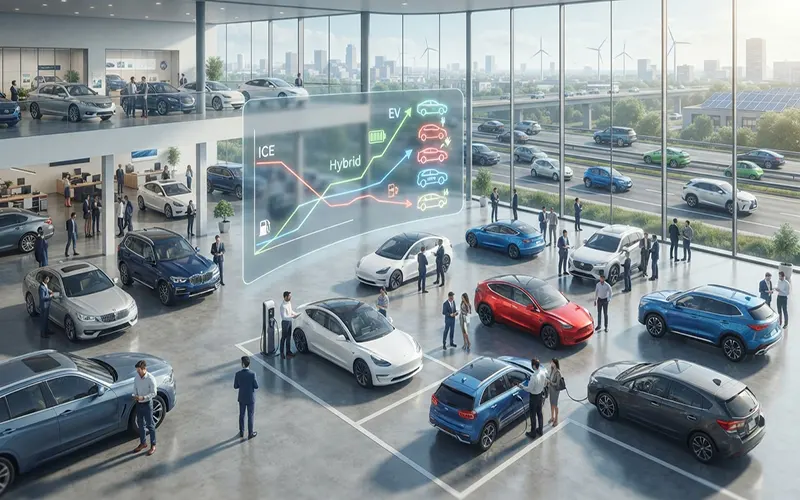
For over a century, global new auto sales volume was dictated by a single, straightforward metric: internal combustion engine (ICE) throughput. Dealership lots rose and fell on the cadence of traditional gas-powered vehicle production, and macroeconomic shifts were mirrored directly in tailpipe assembly lines. Today, however, monthly sales reports and showroom floors reflect a profound structural shift.
The rapid ascent of electric vehicles (EVs) and hybrid electric vehicles (HEVs) is fundamentally reshaping total new auto sales volume, influencing inventory turnover, shifting market share dynamics, and redefining profitability across the global automotive sector.
The Changing Sales Mix: ICE Decline vs. Electrified Surge
The traditional automotive sales pie is undergoing its most aggressive division in modern history. As environmental regulations tighten and consumer preferences evolve, gas-powered vehicle sales are steadily yielding ground to electrified alternatives.
However, the velocity of this transition varies dramatically by powertrain type:
- The Electrified Share Realignment: Electrified models now account for a massive double-digit percentage of global new car sales volume, breaking past historic threshold barriers.
- The Hybrid Growth Engine: While battery electric vehicles capture considerable media attention, hybrids (HEVs and PHEVs) have served as an explosive growth engine. By lowering the barrier to entry, eliminating range anxiety, and providing immediate fuel savings without requiring lifestyle changes, hybrids are pulling massive volumes of hesitant buyers away from legacy ICE segments.
Economic and Supply-Side Pressures on Sales Volume
The macro-level volume of new car sales is heavily dictated by cost friction and manufacturing capabilities.
- Pricing and Affordability Barriers: Initial purchase price premiums and shifting interest rates have introduced significant price elasticity into the market. While high-end buyers adopted early EV iterations rapidly, expanding total sales volume into the mass market requires achieving cost parity with traditional internal combustion cars.
- Production Flexibility and Inventory Allocation: Automakers have learned painful lessons from over-allocating capital to single-powertrain lines. Today, successful manufacturers utilize flexible manufacturing plants capable of scaling ICE, hybrid, and EV production dynamically. This flexibility prevents lot stagnation and keeps overall sales volume stable when specific segment demand fluctuates.
Regional Disparities and Regulatory Catalysts
The impact of electrification on sales volume is far from uniform across international borders; distinct regional behaviors are dictating global numbers.
- Global Market Divergence: Markets like China have accelerated past historic adoption curves, where new energy vehicles capture nearly half of domestic sales volume. Meanwhile, North American and European markets experience more gradual, cyclical adoption shaped by regional charging infrastructure development and shifting government purchase incentives.
- Mandates and Fleet Targets: Government emission standards and Zero-Emission Vehicle (ZEV) mandates act as forced catalysts. Dealerships and OEMs are compelled to push electrified inventory to avoid severe regulatory penalties, altering what vehicles are heavily marketed and ultimately delivered to consumers.
Future Sales Landscape
Electrified models are no longer a niche experimental segment or a passing industry trend—they are the primary engine driving modern automotive market evolution. As battery prices stabilize, charging infrastructure matures, and powertrain options diversify, total new auto sales volume will continue to decouple from legacy internal combustion dependencies, marking a permanent milestone in automotive history.