
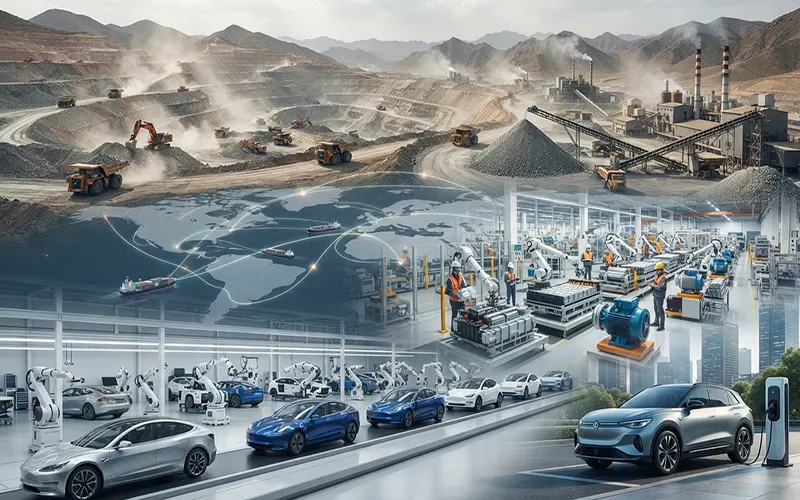
The electric vehicle (EV) transition is frequently framed as a grand battle of battery chemistries—a high-stakes race dominated by lithium, cobalt, and nickel supply chains. However, running parallel to the battery debate is a quieter, potentially more volatile chokepoint that threatens the assembly lines of the world’s leading automakers: the permanent magnets powered by rare earth elements (REEs). While automotive executives and policymakers have poured trillions of dollars into securing cell manufacturing and gigafactory infrastructure, severe vulnerabilities in the upstream and midstream rare earth supply chains pose an existential risk to production continuity, vehicle affordability, and the aggressive speed of the global decarbonization timeline.
The Invisible Engine: Why Rare Earths Matter to EVs
To understand the vulnerability of modern clean mobility, one must look beneath the hood at the propulsion system. The vast majority of long-range, high-efficiency battery electric vehicles rely on permanent magnet synchronous motors (PMSMs). Unlike traditional induction motors, PMSMs utilize specialized permanent magnets containing critical rare earth elements—most notably neodymium (Nd), praseodymium (Pr), dysprosium (Dy), and terbium (Tb)—to maximize power density, torque, and energy efficiency.
The scale of this material requirement fundamentally alters how automakers interact with heavy industry. While an internal combustion engine (ICE) vehicle relies primarily on base metals like steel, aluminum, and copper, a modern electric vehicle motor requires kilograms of high-grade rare earth magnetic material. Because these permanent magnets determine how efficiently a vehicle converts battery energy into motion, scaling global clean transport is inextricably bound to geological extraction capabilities, complex chemical separation formulas, and high-tech metallurgical processing.
The Geopolitical Chokepoint and Market Vulnerability
The Achilles’ heel of the EV rare earth supply chain is its extreme geographic and structural concentration. For decades, the global market has depended heavily on a single dominant player—China—which maintains a near-monopoly spanning from raw mineral mining to complex chemical separation, metal smelting, and the production of sintered permanent magnets.
This concentration creates profound market vulnerability. Recent years have underscored how rapidly trade friction, export restrictions, and geopolitical leverage can disrupt international commerce. When regulatory bodies or exporting nations implement licensing friction, environmental quotas, or direct controls on medium and heavy rare earth exports, global supply chains experience immediate shockwaves. Automakers face sudden cost spikes, component shortages, and the constant threat of having to temporarily throttle or idle vehicle assembly lines. According to data and risk assessments from institutions like the International Energy Agency (IEA), the economic exposure of the global automotive sector to a sudden rare earth supply disruption scales into the hundreds of billions of dollars, threatening to stall the transition away from fossil fuels.
Automaker Strategy: Adaptation, Substitution, and Resilience
Faced with mounting supply chain risks, legacy automakers and EV pioneers are aggressively reshaping their engineering and sourcing strategies to insulate themselves from single-nation reliance.
1. Engineering Workarounds and Motor Redesign
Engineers are racing to reduce or entirely eliminate rare earth dependency. This has triggered a resurgence in the development of alternative motor architectures, such as advanced induction motors and wound-rotor synchronous motors, which operate without rare earth permanent magnets. Simultaneously, tier-one suppliers are engineering heavy-rare-earth-free permanent magnets—such as enhanced ferrite formulations or specialized grain-boundary diffusion techniques—that drastically reduce the need for scarce elements like dysprosium without sacrificing motor performance.
2. Friend-Shoring and Regional Ecosystems
Western and allied governments are enacting robust policy measures, including the G7 critical mineral action plans, the U.S. Inflation Reduction Act, and European raw materials acts, to jumpstart domestic mining and midstream processing. Billions of public and private dollars are flowing into projects across North America, Australia, Europe, and parts of Africa to build independent supply networks.
3. The Industrial Equipment Bottleneck
Despite capital availability, diversification remains agonizingly slow. Building an alternative rare earth refining facility or magnet production plant is not merely a matter of funding; it requires highly specialized chemical engineering expertise, strict environmental compliance infrastructure, and long lead times—frequently taking five to ten years from exploration to commercial output.
the Road Ahead
Ultimately, the global transition to electric vehicles is just as much a raw-materials and processing challenge as it is an automotive engineering feat. The heavy reliance on vulnerable rare earth mineral supply chains highlights a fragile link at the heart of the green energy revolution. Over the coming decade, the ultimate success of the EV transition will not only depend on battery breakthroughs or charging infrastructure rollouts, but on whether the global auto industry can successfully decouple its supply chains from single-nation dependencies before geopolitical friction outpaces industrial adaptation.